
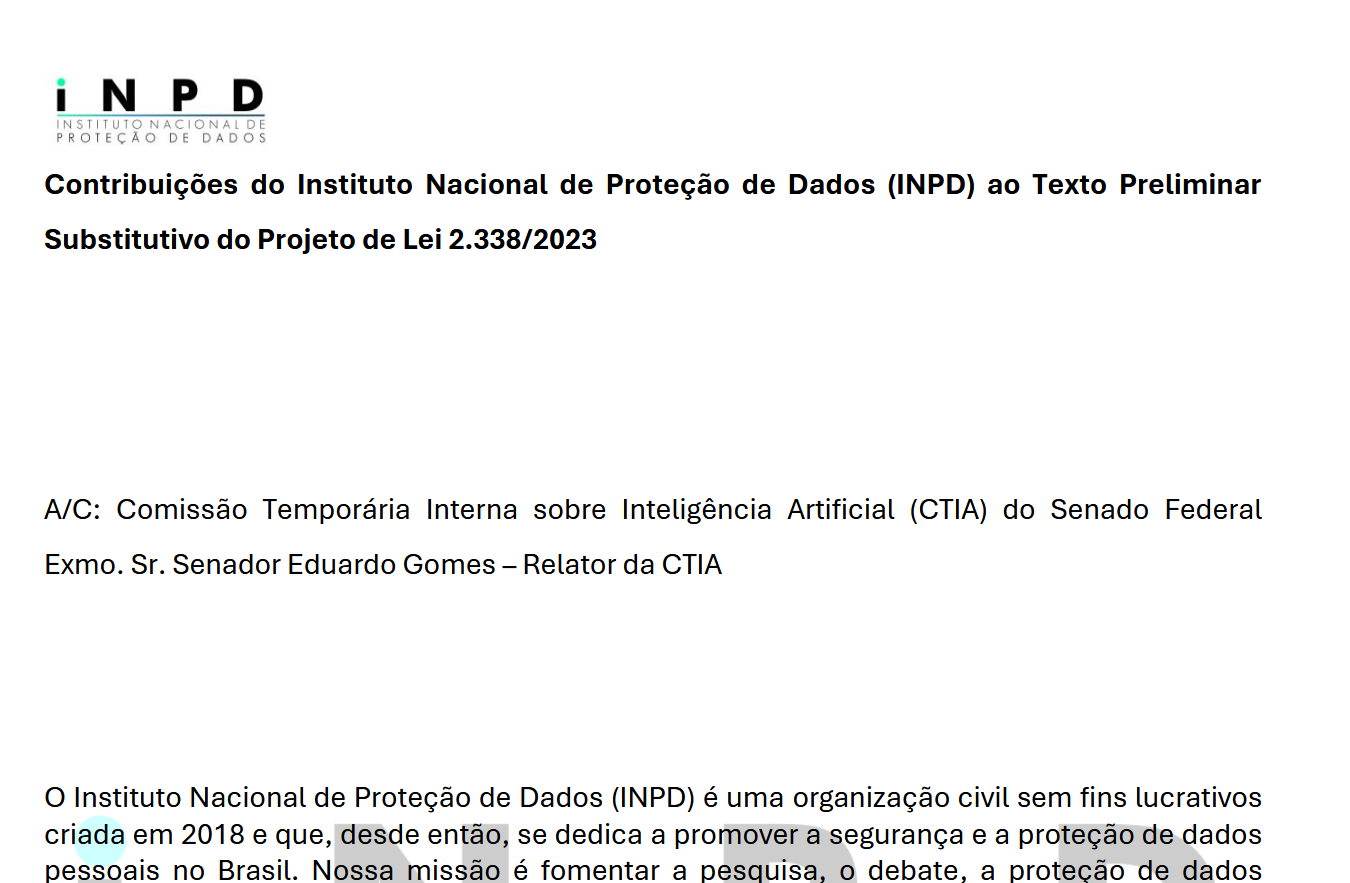
The National Data Protection Institute (INPD) submitted to the Federal Senate’s Temporary Internal Commission on Artificial Intelligence (CTIA) its suggestions for amendments [1] to Bill No. 2338 [2], which establishes various rules related to the development and implementation of artificial intelligence systems by companies. The bill also aims to provide safeguards for individuals regarding their right to know how to interact with an AI system and to understand the outcomes of automated decisions.
The technical contributions presented by the National Data Protection Institute stemmed from a process of actively listening to the concerns of members and researchers, which led to suggestions aimed at refining and improving the text under discussion.
“Despite the clear effort to present detailed regulations with numerous obligations aimed at artificial intelligence operators, our view is that the text fails by attempting to regulate the technology itself, rather than its applications. In this regard, we propose amending overly broad concepts, as well as aligning the text with legal principles already established in Brazil,” notes Rafael Reis, president of the INPD.
Among the points discussed is the suggestion to change the term “artificial intelligence system” to “artificial intelligence techniques,” which, in the INPD’s view, provides for more precise and appropriate regulation in that it focuses on the specific methodologies and uses of the technology, rather than attempting to encompass the technology itself.
With regard to the powers of the SIA’s coordinating body, for example, it was recommended that the proposed regulation—in accordance with the stated purpose of the law, namely economic, technological, and scientific development and innovation—prevent agents from being subject to multiple sanctions by different agencies, thereby avoiding “bis in idem.”
Regarding the proposal to accredit institutions to ensure greater effectiveness than what was originally proposed, it was suggested that these institutions possess expertise related to the sector in which AI is being developed, in addition to technical knowledge of computer science in the field of AI.
A point of extreme importance—given its direct impacts on both those involved in AI and the safe development of the technology itself—is that the wording of Article 33 of the Bill, in its original form, applies to cases of both strict and fault-based civil liability. Therefore, the exemptions provided for in subparagraphs I and II establish grounds for AI agents that cause harm to users—regardless of the risk classification of their activity or the type of civil liability—to be exempt from liability, provided that the specified conditions are met.
The INPD considers, however, that this provision should be revised, given that agents who make available artificial intelligence techniques that pose excessive risk—which are prohibited by Article 13 of the bill and fall under the rule of strict liability—will only be able to invoke the exemption provided for in Article 33(I). The possibility of exemption from liability should be conditional, in these specific cases, on proof of no involvement in the distribution, use, or benefit derived from the AI system, thereby avoiding any compromise of the principle of full compensation for damages provided for in Article 3, IX, of the Bill.
Agents who make available practices prohibited by Article 13, II, of the bill shall bear full liability for any resulting damages, even if such damages are attributable to users or result from an external fortuitous event, thereby ensuring that irresponsible and legally prohibited use is not left uncompensated.
These were, therefore, some of the suggestions for better alignment with the proposed regulation in question, noting once again that the National Institute for Data Protection (INPD) believes that, given the importance of the issue, any legal regulation should be preceded by an in-depth debate with society, particularly with computer science experts and legal scholars, while also monitoring the developments of existing AI regulations, especially the AI Act in the European Union, thereby enabling learning and refinement based on the practical challenges that will inevitably arise for the European community.
Opinion on AI Regulation in Brazil
Opinion
Rafael Reis, Martha Leal, Atílio Braga, Izabela Lehn, and Aline Macohin
May 31, 2024
27
Ph.D. in Law from UFPR. Master’s degree in Applied Computing from UTFPR. Professional with 15 years of experience. Author and speaker in the field of Law and Artificial Intelligence.
Copyright © 2024. All Rights Reserved.