

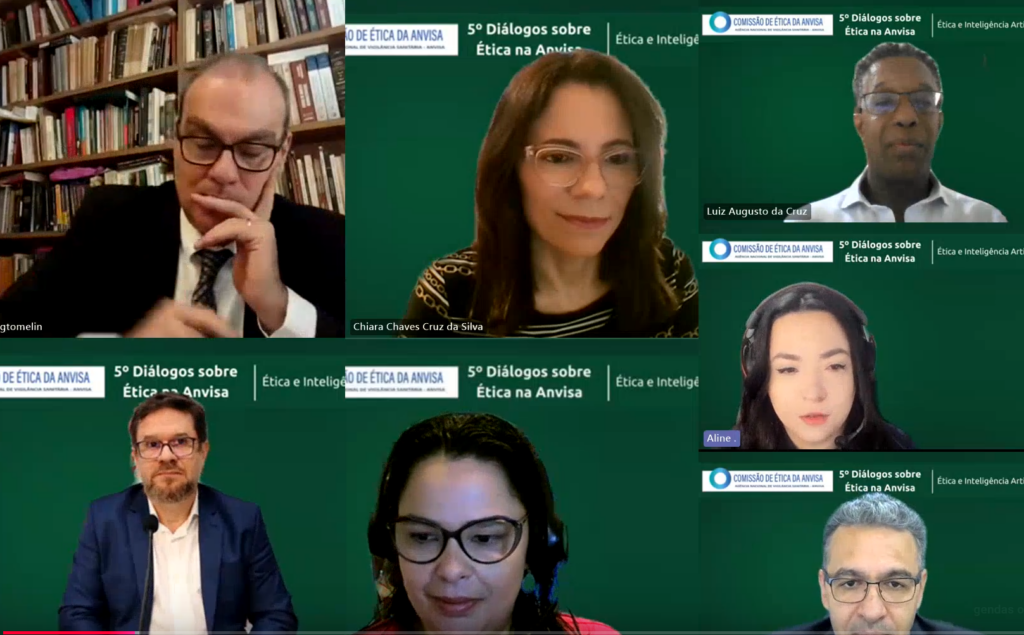
Anvisa’s Ethics Committee (CEAnvisa) held the 5th edition of the event “Dialogues on Ethics at Anvisa” this Friday (October 18). The online event focused on the theme of Ethics and Artificial Intelligence (AI), featuring speakers Aline Macohin, an analyst specializing in Artificial Intelligence Governance in the Public Sector, and Georghio Tomelin, an advisor to the Public Ethics Commission of the Office of the President. Tibério Romão, a representative of the National Forum for the Management of Ethics and Integrity in Public Administration, moderated the discussion.
At the opening of the virtual meeting, CEAnvisa President Luiz Augusto da Cruz highlighted the purpose of the “Dialogues” in fostering an open environment for discussion on best ethical practices in public service, with the aim of strengthening issues such as morality and education in professional ethics. Next, Anvisa Director Rômison Mota congratulated the staff members who carry out the Commission’s work and noted the timeliness and relevance of the chosen topic. “The ‘Dialogues’ are important because we need to take a preventive approach. In the case of AI, we must better understand its concept and limitations in order to lay the groundwork for using this tool safely,” observed the Agency director.
Following the screening of an introductory video on AI, speaker Aline Macohin discussed the life cycle of an AI system, the responsible development of technologies, Brazil’s AI strategy, the challenges of applying ethics to AI systems, and the characteristics of an ethical AI system, among other topics. Regarding the characteristics of an ethical artificial intelligence system, the expert emphasized the importance of understanding the system’s limitations and potential errors, as well as how the system arrives at its results. She also highlighted the need for users to be guided on how to make proper use of the system, for system developers to have an AI governance policy and codes of conduct, and for human supervision or review of the results. According to the speaker, it is also essential to avoid variables that could have a discriminatory impact or perpetuate discrimination, and to ensure that someone is held accountable for the system in the event of harm.
The lecture by Georghio Tomelin, an advisor to the Public Ethics Commission of the Office of the President, focused on artificial intelligence applied to medicine. According to him, AI should support doctors in improving the practice of medicine for the benefit of all, without bias. It should also be used to save time spent on study and continuing education, minimize the chances of error (and not generate errors on a large scale), establish priorities and safety standards (and not cut corners to save resources), and enable faster interpretation of images and other test results (and not overlook the big picture of symptoms). “We are undoubtedly entering a new era in medicine with AI,” stated Georghio Tomelin.
Learn more about CEAnvisa
CEAnvisa is an advisory body to the Collegiate Board, the Agency’s employees, and the general public on matters of ethical conduct by public officials. Established in 2002, its mission is to promote ethics and ensure compliance with the Code of Professional Ethics for Public Servants and Anvisa’s Code of Ethics. It consists of three regular members and three alternate members, who are permanent staff members nominated by the Commission’s members from the institution’s talent pool and appointed by the CEO for three-year terms, with one reappointment permitted.
The non-exclusive duties of members of the Ethics Committee take precedence over the activities inherent to the positions they hold in their respective units. It is the responsibility of CEAnvisa to respond to inquiries regarding ethical regulations, provide guidance and advice on the ethical conduct of employees, recommend and monitor training initiatives on ethical conduct standards, receive complaints and initiate proceedings to investigate facts or conduct, impose disciplinary sanctions, establish Conduct Agreements, and propose reeducation measures.