

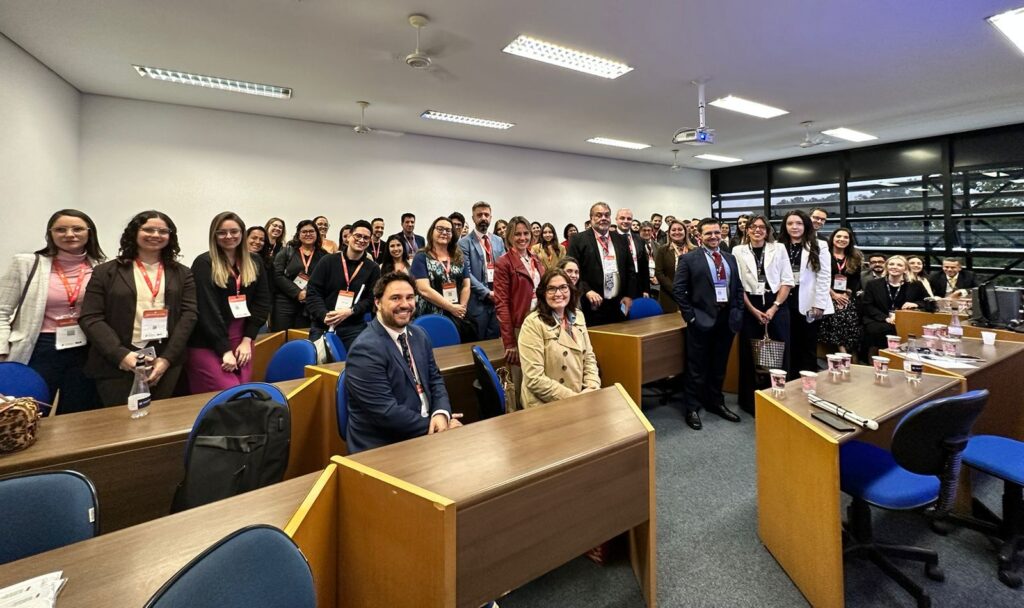
Source: https://www.oabpr.org.br/temas-variados-abrem-a-programacao-do-oab-hub-nesta-sexta-feira/
The first panels at the OAB Hub this Friday addressed the regulatory framework for sustainable finance, the role of women in politics, alternative forms of conflict resolution, the impact of digital transformation on the legal profession, and consumer relations.
Sustainable Finance
The discussion on the regulatory framework for sustainable finance was organized by the Environmental Law, Banking Law, and Corporate Law committees and featured presentations by Maick Dias, Carlos Luiz Strapazzon, and Manoel Gustavo Trindade, with Gustavo Brandalise serving as moderator.
“The Paris Agreement set such ambitious environmental goals that the issue of sustainable finance was sidelined. We need a three-pronged approach: economic development, environmental issues, and social progress. The first step is to reach an agreement on a taxonomy defining what constitutes sustainable finance,” said Strapazzon.
Women in Politics
The Women Lawyers and Electoral Law committees organized a panel discussion on issues related to gender quotas in the electoral arena. The topic was discussed by Bianca Maria Gonçalves e Silva and Gabriela Gonçalves Rollemberg. Nahomi Helena Santana served as moderator.
“There are many forms of violence inflicted on women in the political and electoral spheres. We need to create an environment conducive to the electoral process and to the exercise of public office. The challenges range from the struggle to gain access to the candidate list to the difficulties faced while in office, including securing campaign funds,” noted Bianca Silva.
Conflict Resolution
Luciana de Andrade Amoroso Remer, Fabiano Neves Macieywski, João Carlos Adalberto Zolandeck, Flávia Aparecida Antunes, Fernanda Scheibe Anderson, Gregório Guimarães von Paraski, and Victoria Sbruzzi Messnar discussed alternative dispute resolution methods during the panel organized by the committees on Mediation, Collaborative Law, Arbitration, Family Law, Environmental Law, Business Law, and International Law.
“In mediation, we must balance the combined use of legal rationality and economic rationality to maximize benefits. A family business needs both a viable business and a healthy family,” argued João Carlos Zolandeck
Digital Transformation
The impacts of digital transformation on the legal profession, the digitization of legal proceedings, artificial intelligence tools, and the challenges of including the legal profession in this process were discussed during the panel organized by the Digital Law and Data Protection, Management and Entrepreneurship, and Law Firms committees. The panel featured presentations by Sávio Teles, Wlademir Roberto Vieira Júnior, Tainá Aguiar Junquilho, and Aline Macohin.
“Regulating the use of artificial intelligence is a challenge that is on the agenda worldwide. Brazil has introduced Bill 2338/2023 for this purpose. UNESCO has already issued guidelines for the ethical application of artificial intelligence. It is hoped that the few countries not seeking regulation will at least follow these guidelines,” noted Aline Macohin, who maintains the website Responsible Artificial Intelligence (click here).
Consumption
The Commission on the Rights of Older Adults, the Banking Law Commission, and the Consumer Law Commission hosted a panel discussion on current issues in consumer law, featuring presentations by Juliana Dela Justina Oliveira Prost, Andressa Jarletti Gonçalves de Oliveira, and Antônio Carlos Efing.
“The law requires that consumers be provided with prior and adequate information regarding credit transactions. Older adults end up signing up for these services because they want to stop receiving telemarketing calls. It is not uncommon for consumers to never receive the contract, even though the law requires that it be provided. Refusing to provide or failing to deliver the contract is an abusive practice.”
"Whether in physical or digital form, the company must provide consumers with access to the contract," Efing emphasized.